Thursday the 6th was an ‘at leisure’ day in Swakopmund. Some went quad bike riding in the local sand dunes at an early hour. Some (eg Ness and Mark) took the chance for a rare sleep in past 0600.
The rest of the day was spent in walking around Swakopmund, acquiring some extra $US for Zimbabwe, poking around various touristy shops and having a coffee. Good coffee is rare in Namibia, Swakopmund has a few coffee places that could even survive in Melbourne…
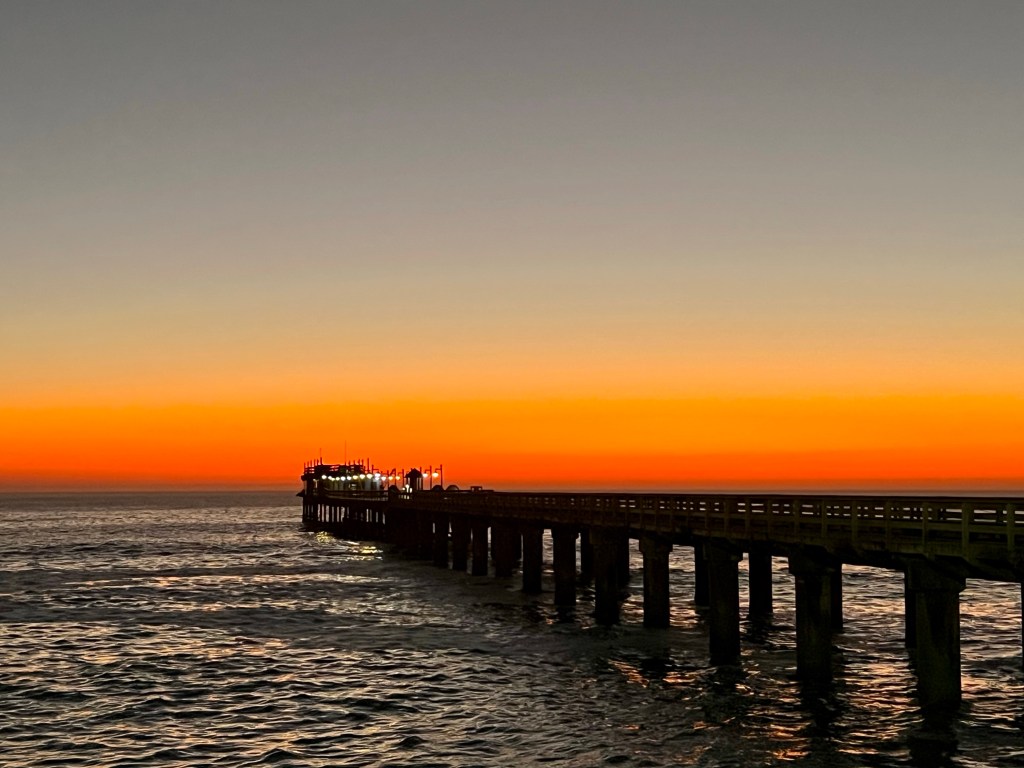
Sunset saw the group at a bar / restaurant over looking the pier for sundowners. This was followed by a nice dinner at another restaurant close to our hotel. A highlight was a nice Sav Blanc made with grapes from one our travelling companion’s wine farm in the Western Cape. Well done on the viticulture Kevin!
On Friday morning we were off again, Mark being a little worse for wear as he succumbed to an onslaught of ‘Bali Belly’. It made for an uncomfortable day…
Two more people joined the group on Friday morning in Swakopmund. Mel and Matt are from San Francisco and will be travelling through to Victoria Falls with us.
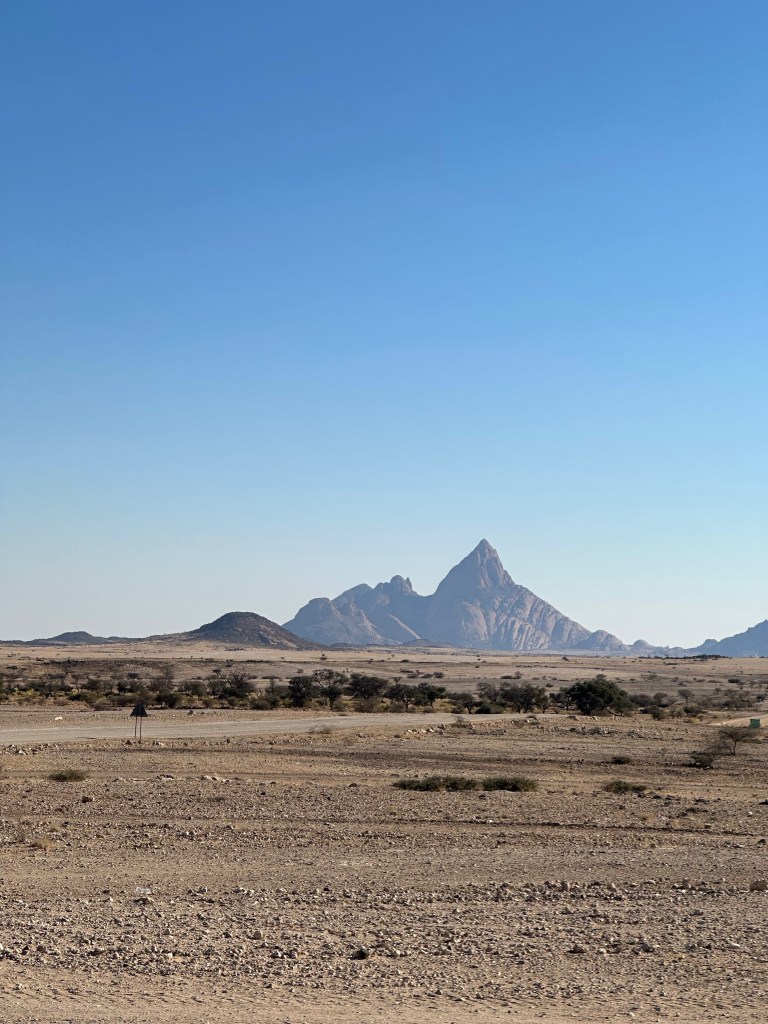
After an hour on tar roads heading back through the desert in the general direction of Windhoek we turned north-ish onto yet another crappy and corrugated dirt road. Our destination was Spitzkoppe, which we could see on the horizon.
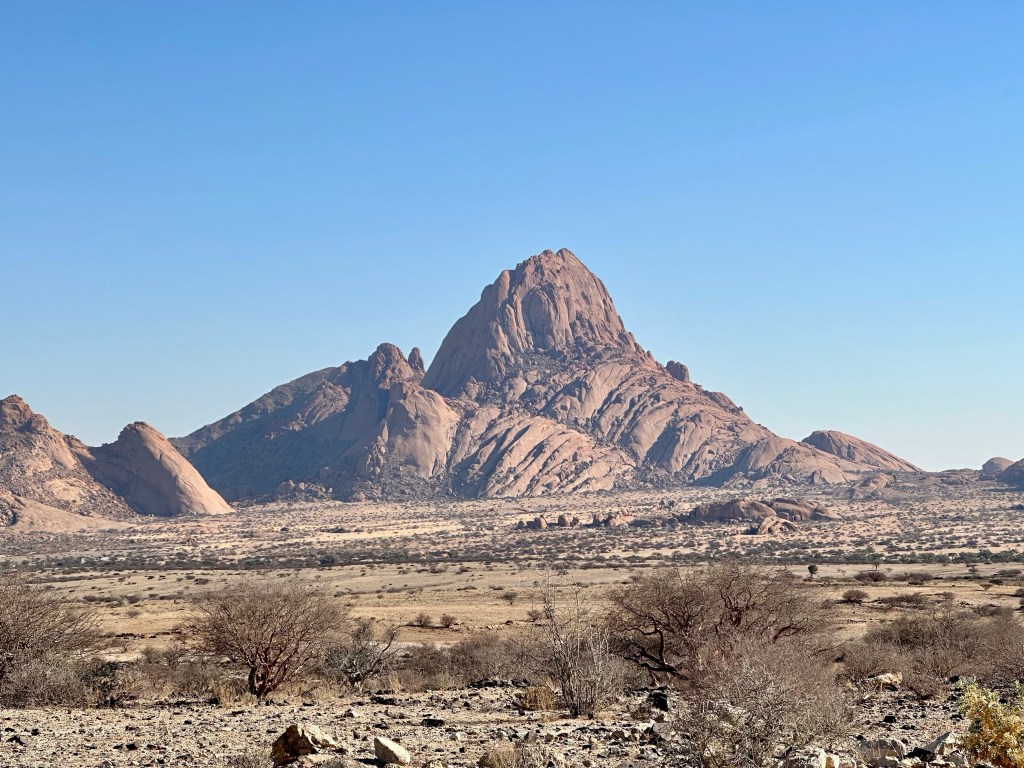
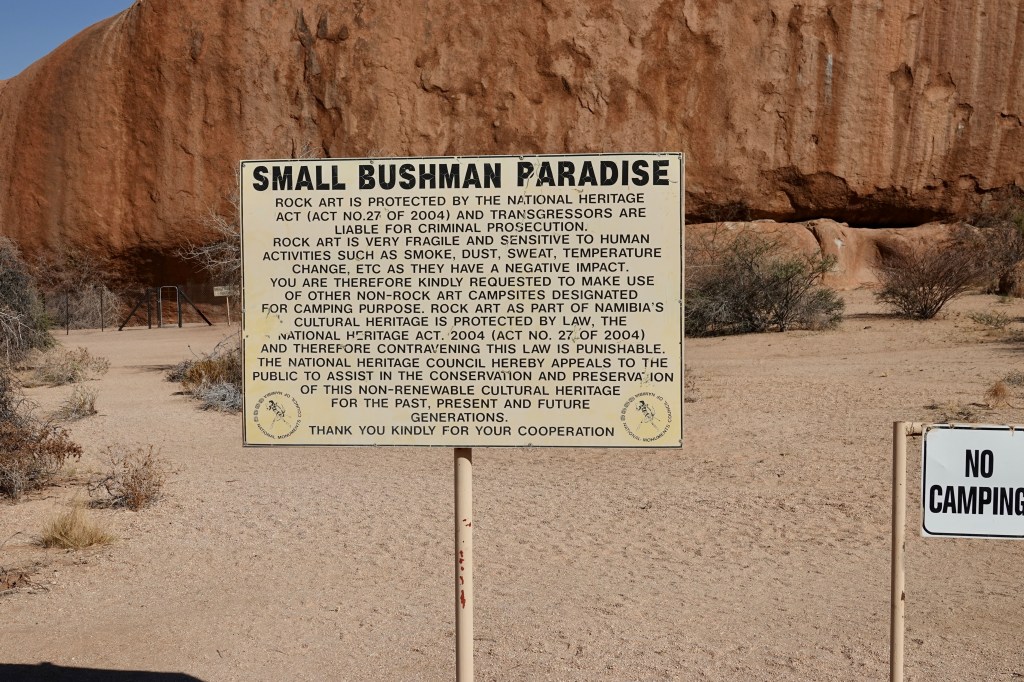
Spitzkoppe (apparently meaning ‘pointy hill / hills) is a conservation area that features San (Bushman) paintings up to 2,000 to 4,000 years old. The area is reminiscent ( in parts) of Kata Tjuṯa in Central Australia, with eroded granite domes and peaks rising between 1,000 and 1,200 metres above the surrounding desert.
The San paintings were amazing. A local guide, John, explained them to us and some aspects of what they conveyed and why they mattered to the San. It was a good experience.
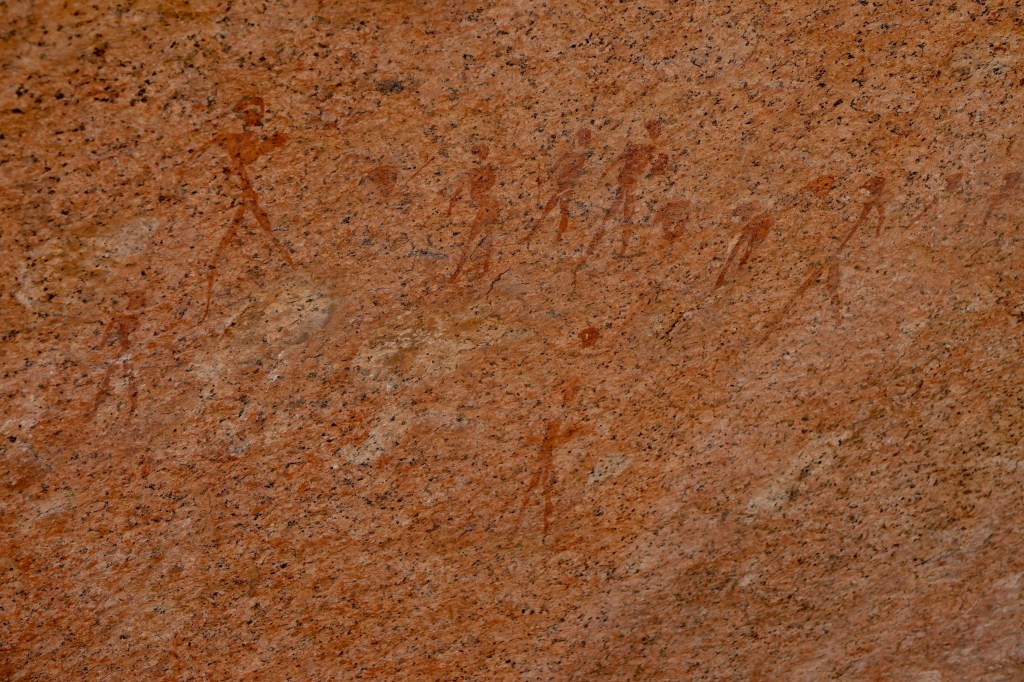
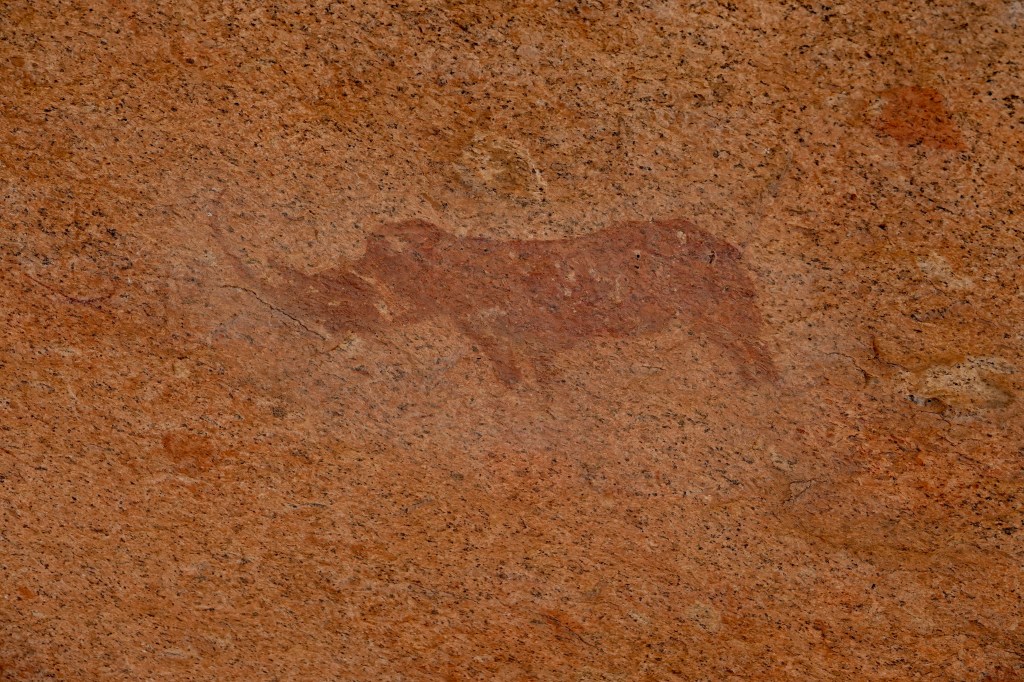
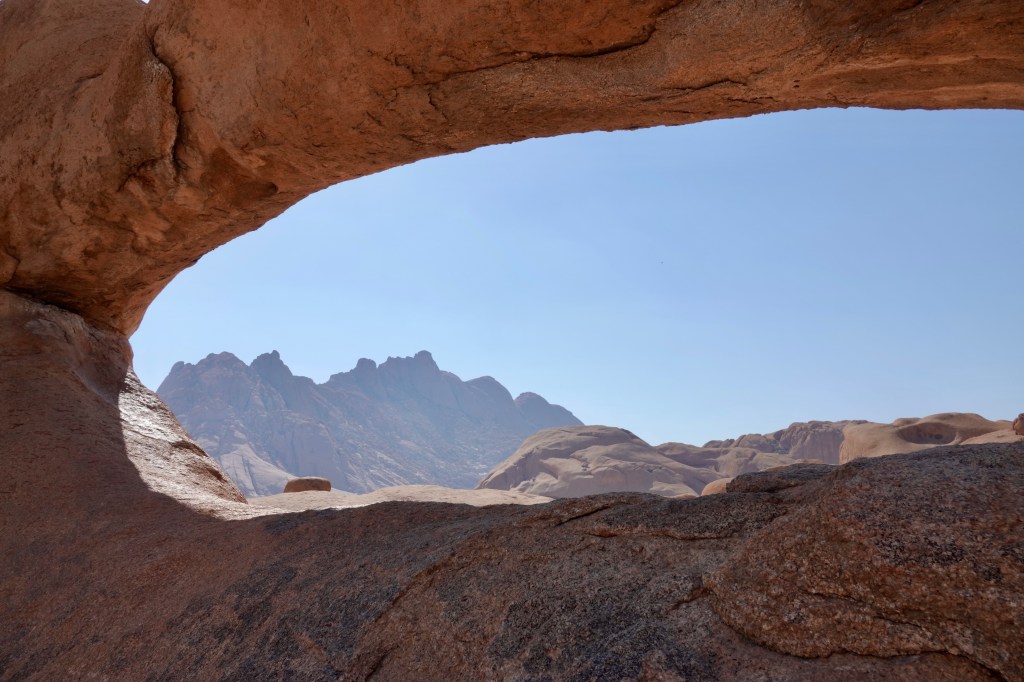
After the paintings we walked around a kilometre and a half though the area to another outcrop with a ‘window’ eroded through it, framing the sky and surrounding area. After photographs it was lunch by the truck and off for a few more hours of shitty corrugated roads. About 90 minutes later we paused for a comfort stop in the tin mining town of Uis. The name ‘Uis’ means ‘dry’ in the local Damara language. The place is aptly named.
Another hour of kidney rattling and we reached our overnight stop at the foot of the Brandenburg Mountains- the ‘Brandenburg White Lady Lodge’. The area apparently has desert Elephants around the place , but we didn’t see any. Upon arrival Mark , still feeling crook had a two hour Power Nap, to not much avail. Dinner was up at the main lodge, Ness said the Oryx fillet roast was good, Mark didn’t participate in dinner. Back at the room and it was time for some serious antibiotics for Mark that our GP had prescribed in Australia with just such a situation in mind.
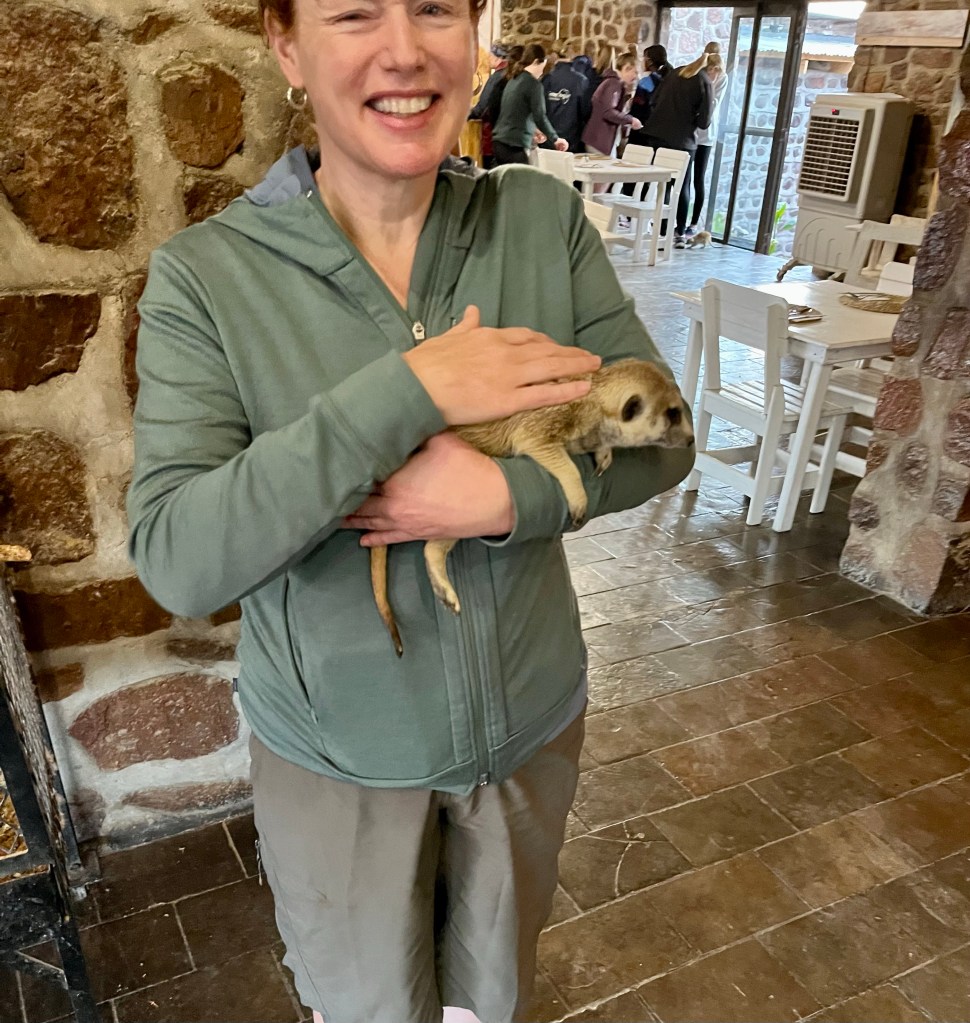
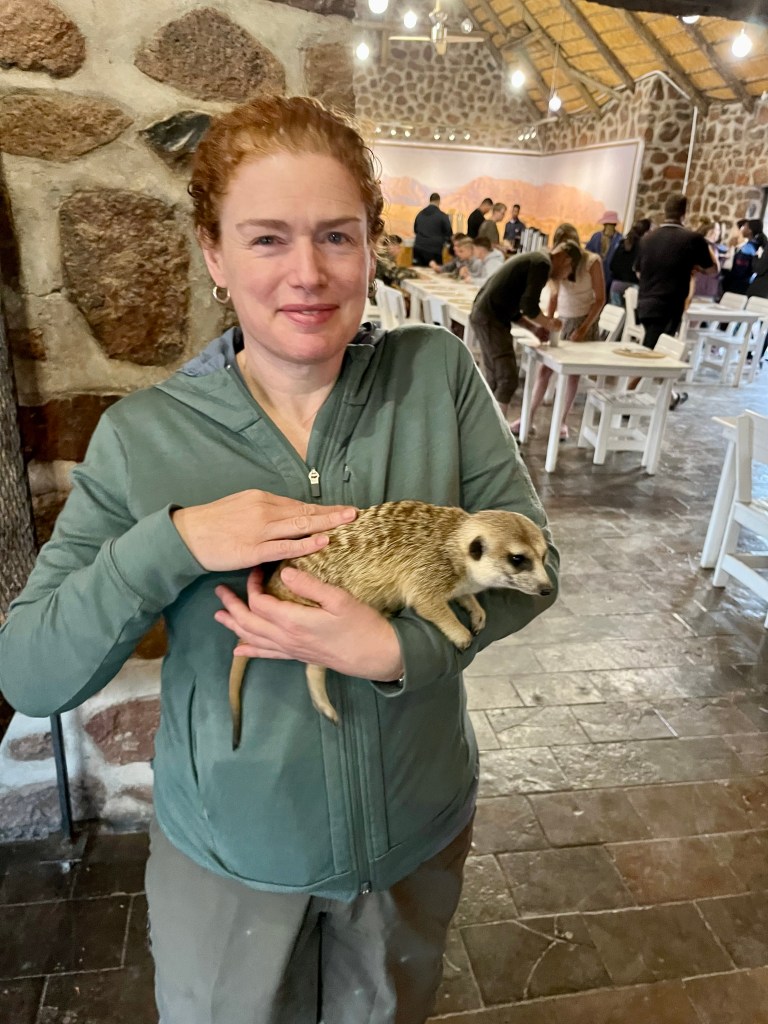
A highlight at Breakfast on Saturday Morning was the presence of the Lodge’s two Meerkats. Ness was all smiles – the only animal she had really, really, really wanted to see in Africa was a Meerkat, so she was very happy. She even got to cuddle one of them!
After breakfast and Meerkat time it was back in the truck for about a 30 minute drive to the car park for the ‘White Lady’ walk up a gorge in the mountains ( around 5km return). Mark didn’t take part in the walk into the gorge because of the requirement to stay near ‘facilities’ – the antibiotics were working, just unfortunately not quite quick enough🤢.
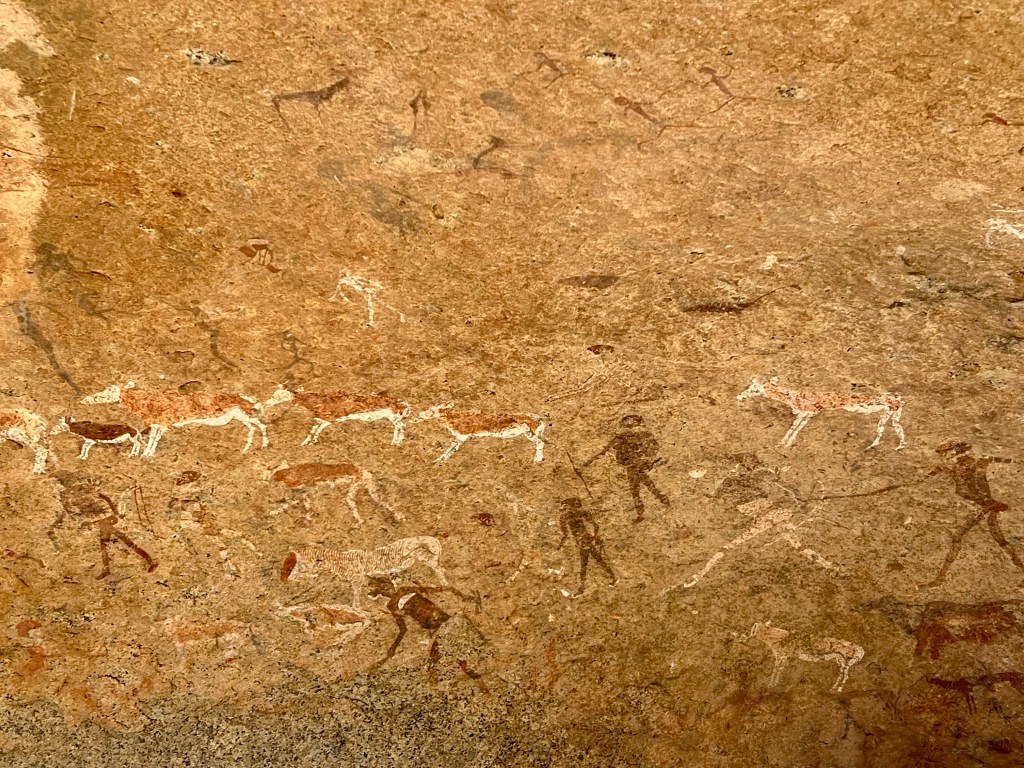
The story of the ‘White Lady’ is interesting. Spoiler alert- the San rock painting labelled the White Lady is neither of a lady or a white person.
Story goes that a local geologist and naturalist was seeking shelter from the midday heat up in one of the narrow gorges in the Brandenburg Mountains and came across the previously unknown to Europeans painting. He was impressed, made some sketches and noted the location. Eventually the images made their way to Cape Town and were sent onto a French Dude in Europe who had made his name studying ancient cave paintings in France.
Excited by what he saw in the sketches, the French dude went to the site , then declared the painting was of a ‘white woman’. The name then stuck. The only problem was the French dude knew nothing of San culture , art or iconography- he was after all an expert in European rock paintings , not African. Turns out the painting is of a San Shaman. And it is a depiction of a male , as females in San culture do not use bows and arrows and are never depicted holding them.
After the walkers returned and cooled down ( the walk was hot) it was back on the truck and the road North.
The standard of road didn’t improve but the country changed over the next few hours. Gradually the desert sands and sparse grasses gave way to thicker vegetation, predominantly various types of prickly acacias up to 3 m high sometimes. The area still had Kopjes of volcanic rocks and hills and mountains in the distance.
There were a few small hamlets along the route, populated by a mixture of Himba and Herero people. Many had small roadside stalls of various degrees of construction where they hoped to attract tourists to stop and buy various treasures.
The stalls seemingly were only manned by women, but there was quite a contrast between the two groups of women. The Herero had been coerced/ cajoled/ encouraged by German missionaries a long time ago to ‘cover up’ . They adopted/ were given long Dutch / German European style dresses and hats (19th century style) which are still worn today. The clothing is colourful, but kind of smacks of a ‘Hand Maids Tale’ vibe.
The Himba on the other hand seemed to have told the German missionaries to stick it. They wear a small skirt and are naked from the waist up. They wear beads around their necks and go to extraordinary lengths to plait their hair. To accentuate the look they also rub themselves all over with red ochre mixed with either butter fat or (more commonly today) Vaseline. The overall effect is striking- and looks just like they have walked off the cover if National Geographic magazine circa 1962…
After lunch of Boerewors literally on the roadside at an intersection we arrived at our destination of Kamanjab. This is a town of around 4,000 people and effectively is the ‘capital’ of the North West part of Namibia. There is a high school, primary school and various government offices. From Kamanjab it is North to Ruacana, then the Angolan border.
We stayed at a lodge on the outskirts of town called ‘Oppi Koppi’ – literally ‘small hill’ . It was a good place, with the obligatory freezing cold swimming pool. They also had Hornbills, Porcupines and Dassies that wandered in at various times for a feed.
The sad part of the evening was watching the rugby union test match between South Africa and Australia live from Pretoria in a bar full of South Africans….
After a good night’s sleep the bags were on the truck early Sunday morning , breakfast taken and we were heading east to Etosha National Park. Everyone was very excited that the first 150 kilometres was on a good tar road! 🛣️😀

 Ness’ and Mark’s Wandering